
How to Stay Ahead of OSHA’s Top 10 Violations of 2025
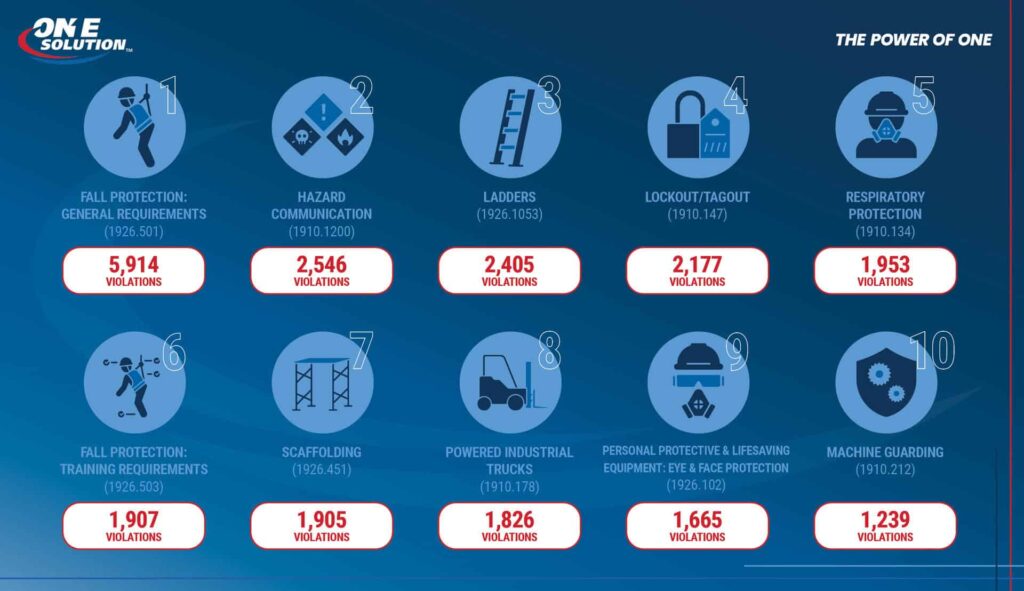
The same preventable hazards keep showing up on OSHA’s “Top 10 Most Frequently Cited Standards.” Here is what separates the employers who stay ahead of them.
Every year, OSHA publishes the ten workplace safety standards most frequently cited during federal inspections. The list rarely surprises safety professionals. The hazard types rarely change. What varies is whether a given employer has already addressed them.
OSHA’s Top 10 Violations list is less a compliance bulletin and more a diagnostic tool.
For employers in construction, manufacturing, warehousing, and general industry, it shows where training, equipment, and program gaps continue to put workers at risk, and where a proactive employer can close them before an inspector does.
The OSHA Top 10 Violations of 2025
1. Fall Protection, General Requirements (29 CFR 1926.501) — 5,914 citations.
Falls remain the most cited hazard in construction for another consecutive year. Employers must provide guardrails, safety nets, or personal fall arrest systems whenever workers face a fall exposure of six feet or more.
2. Hazard Communication (29 CFR 1910.1200) — 2,546 citations.
The Hazard Communication Standard requires a written program, accurate labeling under GHS, an up-to-date Safety Data Sheet library, and training at the time of initial assignment and whenever a new chemical hazard is introduced.
3. Ladders (29 CFR 1926.1053) — 2,405 citations.
Violations typically involve improper ladder selection, damaged equipment left in service, and missed training on three-point contact and safe placement.
4. Lockout/Tagout (29 CFR 1910.147) — 2,177 citations.
The Control of Hazardous Energy standard exists to prevent unexpected machine startup during maintenance. Common gaps include missing written energy control procedures, incomplete authorized employee training, and skipped annual procedure inspections.
5. Respiratory Protection (29 CFR 1910.134) — 1,953 citations.
This standard applies wherever workers face airborne contaminants above permissible limits. Citations most often trace back to a missing written program, skipped medical evaluations, or fit testing that was not completed or documented.
6. Fall Protection, Training Requirements (29 CFR 1926.503) — 1,907 citations.
Separate from the general fall protection standard above, this requirement covers whether every exposed worker was actually trained to recognize fall hazards and follow the procedures meant to control them. Equipment alone does not satisfy this standard.
7. Scaffolding (29 CFR 1926.451) — 1,905 citations.
Common issues include scaffolds erected or modified without a competent person’s oversight, missing guardrails or toeboards, and workers using scaffolds without required training.
8. Powered Industrial Trucks (29 CFR 1910.178) — 1,826 citations.
Forklift operators must be trained, evaluated, and re-certified at least every three years. Daily pre-operation inspections are frequently the first thing an inspection reveals as missing.
9. Eye and Face Protection (29 CFR 1926.102) — 1,665 citations.
Employers must complete a hazard assessment and provide properly fitted eye and face protection at no cost to workers wherever flying particles, chemical splash, or radiant light exposure exists.
10. Machine Guarding (29 CFR 1910.212) — 1,239 citations.
Point-of-operation hazards, nip points, and rotating parts must be guarded, and guards must never be removed or bypassed for convenience.
What Best-in-Class Employers Do Differently
The organizations that stay off this list year after year share a pattern.
They do not treat safety as a once-a-year training event or a folder of paperwork kept for inspection day.
They do build safety into daily operations through:
- Recurring hazard assessments
- Documented training that gets refreshed as equipment and personnel change
- A habit of catching small gaps before they become citations or injuries.
The difference is not always budget. It is often just consistency and a partner who helps identify the gaps that internal teams stop noticing over time.
The Real Cost of Non-Compliance
OSHA penalty amounts increased effective January 15, 2025, per OSHA’s published penalty adjustment and 29 CFR 1903.15.
|
Violation Type |
Maximum Penalty |
|---|---|
|
Serious |
$16,550 per violation |
|
Other-Than-Serious |
$16,550 per violation |
|
Willful or Repeated |
$165,514 per violation |
|
Failure to Abate |
$16,550 per day beyond the abatement date |
The fines are only part of the cost.
A citation often brings production delays while corrections are made, equipment downtime, overtime to cover the gap, higher turnover when workers do not feel protected, added legal exposure, and higher insurance premiums that follow an organization for years after the inspection itself is closed.
Why Employers Trust OneSolution
OneSolution works alongside safety and operations teams as a consultative partner, not a compliance vendor selling a one-time audit. Our team gets to know your facility, your equipment, and your existing programs, then helps close the specific gaps that matter for your operation.
The Value of Our Complimentary Onsite Audits and Assessments
A OneSolution onsite audit gives you a clear, current picture of where your facility stands against common hazard areas, fall protection readiness, ladder condition, emergency fixture placement, PPE fit and availability, and more, without the cost or pressure of a formal inspection. It is the same kind of look an OSHA inspector would take, delivered as a planning tool instead of a citation.
Beyond Compliance: Value-Added Services
Our support extends well past a single audit. Depending on your facility’s needs, OneSolution offers:
- Fall protection awareness support
- Ladder inspections
- Emergency fixture inspections
- Heat stress and hearing protection awareness
- Arc flash support
- AED and trauma response audits
- Matting assessments
- Disaster preparedness support
- PPE audits
- Lighting assessments
- Product demonstrations
- Customized training
- Compliance reviews and program evaluations
- Regulatory guidance
A Partner in Operational Improvement
Workplace safety and operational performance go hand in hand. Fewer incidents mean less downtime, steadier staffing, and a workforce that trusts the equipment and processes it is asked to use every day. OneSolution’s role is to help you get there, not just to help you pass an inspection.
Schedule a Complimentary Onsite Assessment
The hazards behind the OSHA Top 10 are the same ones that show up year after year, and they are also the most preventable. Schedule a complimentary onsite assessment with OneSolution to see where your facility stands and where the next improvement should focus, for your compliance, your operations, and your people. Schedule Your Assessment
About OneSolution: OneSolution is a division of Forward Solutions, serving as a manufacturer representative and consultative partner across sales, marketing, consulting, and training. Our team works directly with employers to bridge product knowledge and workplace safety practices.
About Forward Solutions: Forward Solutions is the parent organization behind OneSolution and its related network, connecting manufacturers, distributors, and employers around shared safety and operational goals.
Learn More
Contact OneSolution about our Value-Added Services
Contact
For media inquiries, contact Jim Moryan, Sr. Marketing Manager, at Jim.Moryan@Forward-Solutions.com.